


You’ve probably heard the term performance marketing everywhere.
Agencies talk about it. Marketing platforms promote it. Businesses say they’re doing it.
But here’s the thing.
Many people still think performance marketing is just about running Google Ads or Meta Ads. It isn’t.
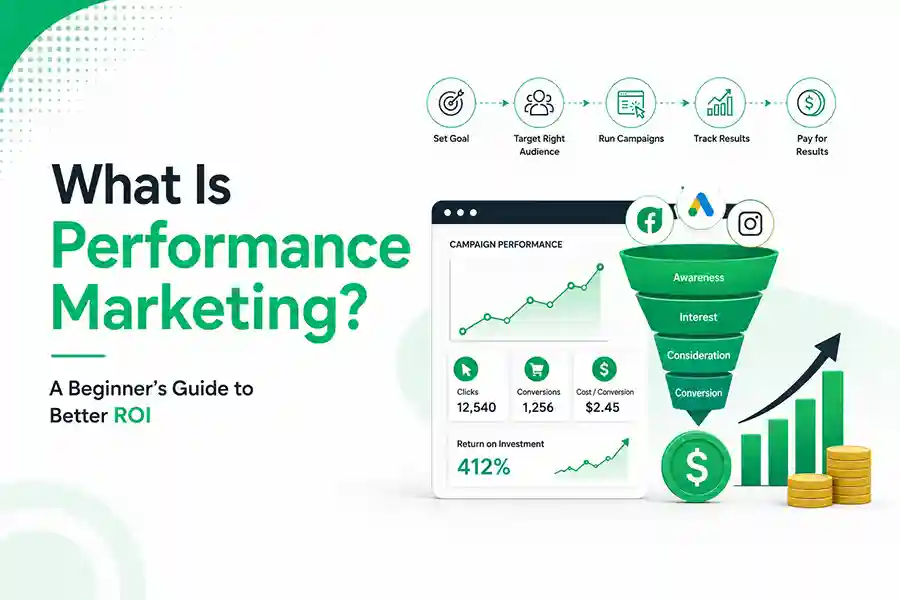
Performance marketing is about knowing where your marketing budget is going and whether it’s actually bringing in results. Every click, every lead and every sale should tell you something. If it doesn’t, you’re simply spending money and hoping for the best.
That’s what makes performance marketing different. It removes the guesswork.
It Doesn’t Start With an Advertisement
A lot of businesses spend hours creating the perfect ad. They choose the right image, write compelling copy and launch the campaign.
Then… nothing happens.
Was the ad bad?
Not necessarily.
The problem often starts after someone clicks the ad.
If your landing page is slow, people leave. If your message isn’t clear, they leave. If your form is too long, they leave.
A great advertisement can only bring visitors to your website. It’s your website that turns those visitors into customers.
That’s why successful performance marketing focuses on the entire customer journey, not just the advertisement.
Performance Marketing Isn’t Limited to Paid Ads
One of the biggest misconceptions is that performance marketing only happens through paid advertising.
In reality, there are several digital marketing channels that can deliver measurable results.
Paid Search platforms like Google Ads help businesses reach people who are actively searching for products or services.
Social Media Advertising on platforms like Facebook, Instagram, LinkedIn and TikTok allows you to target specific audiences based on their interests, behaviour and demographics.
Display Advertising helps increase visibility by placing banner ads across websites and mobile apps.
Video Marketing, especially on YouTube, is effective for building awareness while also driving website traffic and conversions.
Email Marketing continues to be one of the highest-performing channels. It helps businesses nurture leads, recover abandoned carts and encourage repeat purchases.
Affiliate Marketing lets businesses partner with publishers or influencers who earn a commission only when they generate a sale or lead.
Even Search Engine Optimisation (SEO) plays an important role. While it isn’t a paid channel, improving organic rankings brings qualified traffic that can be measured through leads, enquiries and sales.
The best results usually don’t come from relying on just one channel. They come from using the right mix of channels based on your audience and business goals.
Don’t Chase Clicks. Chase Customers.
Getting thousands of clicks feels good.
Getting hundreds of leads feels even better.
But here’s a better question.
How many of those leads actually became customers?
This is where many businesses get it wrong. They celebrate low cost per click or a high number of enquiries without checking whether those enquiries generated real revenue.
A campaign that brings in fewer but better-quality leads is often much more valuable than one that fills your inbox with people who never buy.
The goal isn’t more traffic.
The goal is better business.
Your Customer Data Is More Valuable Than Ever
Digital marketing is changing.
Privacy updates mean businesses can no longer rely entirely on third-party data to understand their audience.
That’s why first-party data has become so valuable.
Every enquiry form, newsletter signup, website visit, and customer purchase gives you insights into what your audience wants. Combined with a good CRM, this information helps you create more relevant campaigns and improve customer experiences.
Better data leads to better decisions.
AI Can Help. But It Can’t Replace Good Marketing.
Artificial Intelligence has quickly become part of modern performance marketing.
It can generate ad copy, suggest keywords, analyse campaign reports and even identify trends faster than ever before.
But AI is only a tool.
It doesn’t understand your customers the way you do. It doesn’t know your business goals or what makes your brand unique.
The smartest marketers use AI to save time while relying on their own experience to make strategic decisions.
The Best Campaigns Never Stop Improving
Performance marketing isn’t something you set up once and forget.
Every campaign gives you new insights.
You can test different headlines, images, audiences, landing pages and calls to action.
Sometimes a small change can improve your conversion rate more than increasing your advertising budget.
That’s why continuous testing is one of the biggest strengths of performance marketing.
The Bottom Line
Performance marketing isn’t about having the biggest marketing budget.
It’s about making smarter decisions with the budget you already have.
Whether you’re using Google Ads, SEO, email marketing, social media advertising or affiliate marketing, the goal remains the same: measure everything, learn from the data and keep improving.
The businesses that consistently test, optimise and adapt are the ones that see the best long-term results.
Because in the end, performance marketing isn’t about running more campaigns.
It’s about running better ones.